YouTube RPM by niche: the real formula, not a lookup table
- What RPM is, and why it's always lower than CPM
- Why no two "RPM by niche" tables ever agree
- Niche sets your CPM: a table with honest sourcing
- Audience geography: the variable bigger than niche
- Getting monetization approved is only the first gate: evidence from 17.6 million channels
- Estimate your own RPM before you launch a channel (4 steps)
- Checklist before you trust an RPM number
YouTube RPM isn't a number you look up by niche. It's the product of four variables: your niche's CPM, the share of your views that actually carry a paid ad, the 55% cut YouTube pays creators, and the variable most ranking tables skip entirely: where your audience lives. Two finance channels can land ten times apart on RPM simply because one channel's viewers sit in the US and the other's sit in a market like Vietnam or India. The right question isn't "which niche has the highest RPM." It's "where does my audience live, and does my niche pull advertisers willing to pay for it."
What RPM is, and why it's always lower than CPM
Per Google's own documentation, RPM is the revenue you actually collect per 1,000 views: ads, channel memberships, YouTube Premium, and Super Chat combined. CPM is different: it's what an advertiser pays per 1,000 ad impressions, calculated before YouTube takes its cut. RPM lands below CPM because of two layers of shrinkage.
First is the revenue split. For ads on the watch page, YouTube keeps 45% and pays creators 55%, the one official, no-asterisks figure in this whole article, stated on Google's ad revenue sharing page. A second layer gets talked about far less: not every view carries a paid ad. Ad blockers, skips, and unsold inventory all eat into the count. That's why real-world RPM usually falls to well under half of CPM, not a clean 55%:
RPM ≈ CPM × share of views with a paid ad × 55% (creator share)
Why no two "RPM by niche" tables ever agree
Search "highest RPM YouTube niches" and you'll hit a wall of tables with suspiciously precise numbers: an RPM of $12.82 for "betrayal storytelling," $11.88 for "learn English." Neither is a category in any advertising taxonomy YouTube actually uses, and the "verified across 3 sources" badge stapled next to them never links to anything. That's staged authority, not data. Some tables go further and mix up RPM with CPM outright, to the point where one site's RPM for a niche beats another site's CPM for that same niche. That only happens when someone got the math wrong.
Your defense is reading the source label before you trust the number. Sort every RPM figure you come across into one of three buckets:
- Official numbers from Google (like the 55/45 split): trustworthy.
- Tool or platform ranges published with a stated methodology (vidIQ, MilX, and similar): directional.
- Third-party numbers with no source cited: treat as a guess.
Niche sets your CPM: a table with honest sourcing
What niche actually decides is CPM: it determines which advertisers show up to bid, and how much they're willing to spend. vidIQ is the most transparent source here, with a range built on "Google Ads benchmark data, publicly available creator earnings reports, and vidIQ's own aggregated data," updated through Q1 2026. vidIQ itself calls this a "directional range, not a guarantee":
| Content group | Estimated CPM range |
|---|---|
| Personal finance | $15–50 |
| Insurance | $20–50 |
| Legal | $15–45 |
| Real estate | $15–40 |
| Gaming | $4–15 |
| Entertainment | $2–8 |
| Music | ~$1–3 |
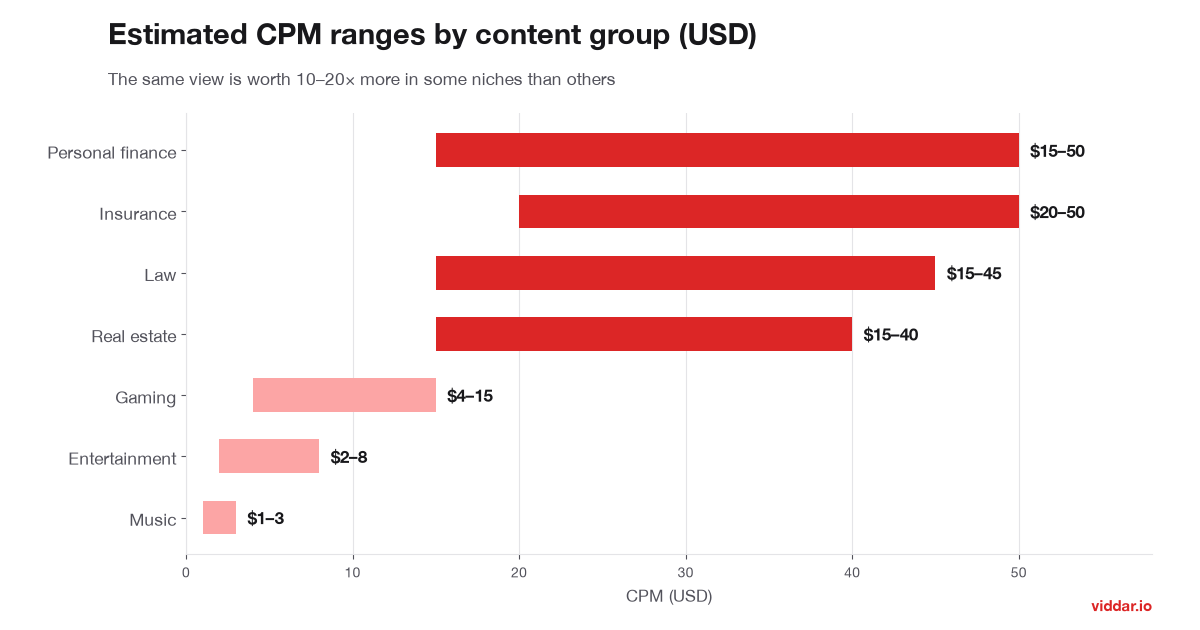
Even two well-sourced numbers disagree with each other. MilX (vendor-aggregated data) puts finance CPM at $15–40, below vidIQ's $15–50. Read this table as a relative ladder rather than a promise: use the ordering between niches, not the absolute figures.
Audience geography: the variable bigger than niche
CPM swings dramatically by where your viewers physically live, and "RPM by niche" tables almost always strip that variable out and never multiply it back in. Per MilX's self-published data:
| Audience in | Estimated CPM (MilX-published) |
|---|---|
| United States | ~$14.67 |
| Australia | ~$13.30 |
| Switzerland | ~$12.98 |
| India | ~$0.74 |
| Pakistan | ~$0.53 |
By MilX's own numbers, the US and India sit nearly 20x apart, about the same spread as the gap between the priciest and cheapest niches. MilX's own conclusion is blunt: where a view comes from sometimes matters more than how many views you get. For an audience like Vietnam's, Vietnamese-language sources put RPM somewhere around $0.5–2, but that figure has no verifiable source behind it. Treat it as directional at best.
That's the trap for any creator building in a lower-CPM market. A Vietnamese-language finance channel, even one sitting in a high-CPM niche on paper, won't see US-style RPM, because most of its viewers are in Vietnam. Country overrides niche here. Swap in a Hindi channel, a Tagalog channel, or an Urdu channel working a high-value topic, and the same math plays out. The single decision that moves your RPM more than any niche choice is whether you build for your local-language audience or for an English-speaking, global one, through English content, dubbing, or a faceless/AI channel.
Getting monetization approved is only the first gate: evidence from 17.6 million channels
RPM only starts to mean something once a channel clears two gates: monetization gets approved, and the channel actually pulls views. Across more than 17.6 million YouTube channels Viddar tracks (an estimate drawn from Postgres statistics, not an exact count, since the table updates continuously), roughly 3.5 million have had their monetization status checked. Of those, only about 17% turn out to be actually monetized. It gets harsher from there: of the roughly 6.9 million channels with a 30-day revenue estimate, close to 80% come out at $0 — most of that group either isn't monetized at all or didn't pull enough views in the window to register measurable revenue. Flip it around, though, and among channels that ARE monetized and have an estimate, only about 8% show $0: once a channel clears the approval gate, most do make something, however small.
A niche full of monetized channels only answers "can this niche make money at all." That's signal #4 in the 5-step process for finding low-competition niches. What actually matters is how much per 1,000 views, and whether the niche pulls enough views for that RPM to turn into real money.
Estimate your own RPM before you launch a channel (4 steps)
Nobody can hand you an exact number, but you can build a reasonable range before you shoot your first video.
- Pick 3–5 comparison channels in the same niche and same language. Language matters as much as niche here, since it decides most of your audience's geography.
- Infer your audience's country mix from language and topic. An English-language finance channel skews toward the US, UK, and Australia; a Vietnamese-language channel skews almost entirely domestic.
- Chain the three layers together: the niche's CPM range (vidIQ's table) × country weighting (MilX's table) × ~55% creator share × the share of views carrying a paid ad. That gives you your own RPM range, not one borrowed from a US channel.
- Multiply that RPM range by a video's median views to estimate revenue. Use the median, not the mean. A high RPM paired with low views still nets you little. This is exactly where RPM pairs with view-to-subscriber ratio (VSR): RPM tells you what each 1,000 views is worth, VSR tells you whether the niche is pulling views in the first place.
Running this math by hand works for one channel; it stops working at a thousand. Viddar pre-computes estimated RPM, monetization status, and 30-day revenue for every channel it tracks, so you filter directly by RPM range or "monetized" inside Niche Hunter instead of checking channels one at a time.
Checklist before you trust an RPM number
- Does the number link to somewhere you can verify?
- Is it RPM or CPM, and does the source actually distinguish the two?
- What audience geography is it calculated for? RPM with no country attached is close to meaningless.
- Is it a real measurement, or a directional range a tool self-published?
- Is the "niche" in the table an actual advertising category, or a catchy phrase someone made up?
- Have you multiplied RPM by median views yet, or are you still staring at RPM on its own?
Almost every tempting RPM figure you find online is the US audience's RPM in an expensive niche, not yours. Build the range for your own audience first, then pick the niche. Do it in the other order and you'll spend months finding out the hard way.
The next niche is already on the radar.
Viddar scans long-form YouTube niche signals every day — free 3-day trial.
Try Viddar for free