How to find low-competition YouTube niches with data (2026)
The most reliable way to find a low-competition YouTube niche is to read data signals instead of trusting your gut: look for niches where NEW channels still pull large view counts relative to their subscribers (a high view-to-sub ratio), where serious competitors are still sparse, and where the growth curve is still sloping upward. A niche that "looks hot" on your YouTube homepage is usually already saturated — what you want is the niche that will be hot three to six months from now.
Why picking a niche by gut feel fails
Most people pick a topic one of two ways: they make what they love, or they copy what's trending. The first ignores the question "will anyone watch this?" entirely. The second has a built-in timing paradox: by the time a niche is visible enough for you to notice it, it's visible enough for hundreds of other creators to notice it at the same moment. You arrive late, the algorithm already has established channels to recommend, and your videos compete against creators with a content library and channel history you don't have.
Put bluntly: you don't lose because you're bad — you lose because you're late.
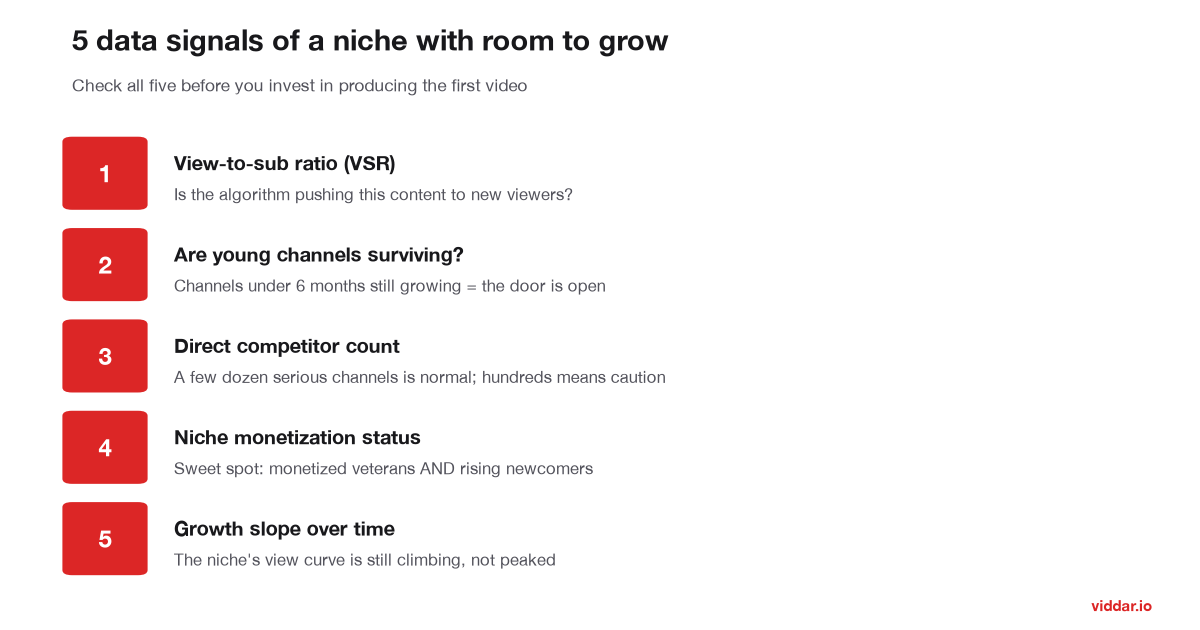
5 data signals of a niche with room to grow
Before you invest in producing a single video, check these five signals:
- View-to-sub ratio (VSR) across the niche. A channel with 10,000 subscribers whose videos consistently clear 100,000+ views means the algorithm is actively pushing this content to new viewers — demand exceeds supply. A million-sub channel getting 50,000 views per video means the niche has cooled. This is the single most important metric in the whole process, and there is a right and a wrong way to compute it — see the full breakdown in view-to-subscriber ratio (VSR).
- Can young channels survive? Filter for channels created in the last six months. If young channels are still growing fast, the door is open. If all the views belong to a few veteran channels, the rankings have frozen.
- How many serious competitors exist. Search the niche's core keywords and count channels that upload consistently with real production effort. A few dozen is normal; several hundred high-quality channels means keep looking.
- Is the niche monetized? Channels accepted into the partner program prove commercial value — but if every channel is already monetized and years old, little room remains. The sweet spot: a niche with proven monetization and fresh channels still breaking in.
- The slope of the growth curve. Compare the niche's average views week over week. The niche worth entering is the one still climbing, not the one that already peaked.
The manual process (free, but slow)
You can absolutely do this by hand:
- Use YouTube search with the "Channel" filter to list channels for each niche keyword.
- Open each channel and record: creation date, subscriber count, average views across the last 10 videos.
- Compute view/sub for each channel and flag young channels with a high ratio.
- Repeat weekly to see which direction the niche is moving.
The drawback: each niche costs you hours, and YouTube gives you no way to scan thousands of niches side by side — which is exactly where the early-mover advantage is decided.
Automating it with a niche radar
This is the problem Viddar was built to solve: it continuously crawls long-form YouTube channel data, pre-computes the signals above (VSR, channel age, growth velocity, monetization status) for every channel and niche, and ranks the least-saturated opportunities on a single radar board. Instead of checking channels one by one, you filter directly — "channels under 6 months old, VSR above 5, niche not yet saturated" — and Niche Hunter returns the list in seconds.
Checklist before committing to a niche
- At least 3 young channels (<6 months) growing well inside the niche
- Average VSR of the leading channels > 2–3
- At least one monetized channel (the niche has commercial value)
- You can sustainably produce ≥1 video per week on this topic for 6 months
- The niche's growth curve is still rising, not past its peak
Choosing a niche is the single biggest decision a YouTube channel makes — it deserves to be made with data, not luck. And if your path is a no-face channel, keep reading: faceless & AI YouTube channels in 2026 — the door is open, just not where it was.
The next niche is already on the radar.
Viddar scans long-form YouTube niche signals every day — free 3-day trial.
Try Viddar for free