Faceless & AI YouTube channels 2026: where's the room?
- What faceless channels are and why they exploded
- The problem: when anyone can do it, niches burn out first
- Which faceless niches still have room in 2026
- Vet a faceless niche with data, not with "income reveal" videos
- Checklist before launching a faceless channel
- The edge is seeing the niche earlier
Faceless channels have never been easier to produce — AI voiceover, AI scripts, and AI visuals cut a long-form video from days of work to a few hours. But precisely because costs dropped for EVERYONE, the competitive edge has moved: in 2026 the winner isn't whoever "can make AI videos," it's whoever picks a niche with room left and puts into each video the kind of effort AI cannot generate on its own.
What faceless channels are and why they exploded
Faceless is the channel model where the creator never appears on camera: videos tell a story with narration over footage, images, motion graphics, or animation. The model is as old as YouTube itself, but three things made it explode between 2023 and 2025: AI voiceover reached human quality, language models write scripts a hundred times faster, and image/video generation removed the need to shoot anything. The technical barrier essentially vanished — one person can now run several channels at once.
The problem: when anyone can do it, niches burn out first
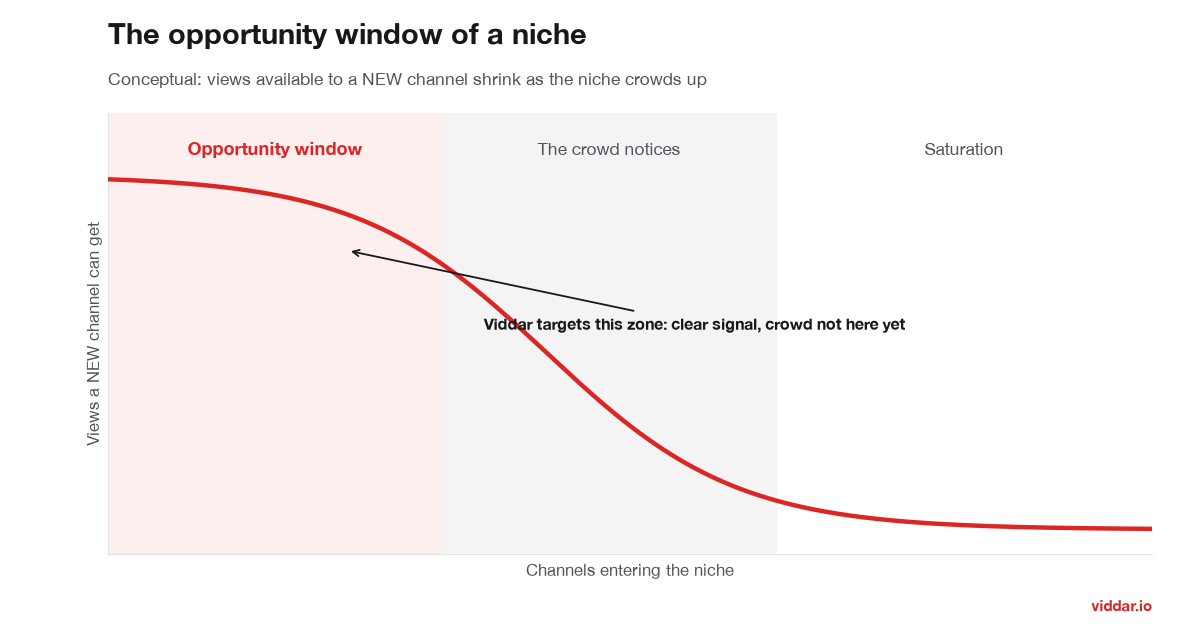
Falling production costs cut both ways. The "formula" niches — music compilations, top-10s read off Wikipedia, fun-facts videos with a robot voice — are where the AI wave poured in first because they're the easiest to clone, and they're also where saturation hit fastest: hundreds of near-identical channels splitting the same audience.
YouTube reacted too: in mid-2025 the monetization policy was updated to clamp down on "mass-produced, repetitious" (inauthentic) content. That doesn't ban AI — it raises the bar: videos must carry transformative value — a point of view, research, an original narrative structure — rather than being the raw output of a tool.
Which faceless niches still have room in 2026
The general rule: the more a niche demands work that can't be automated, the longer it lives. Three families clearly still have a door open:
- Docu-style storytelling. History, case files, business rise-and-fall stories… where the value sits in research and narrative structure — the parts AI can assist with but not replace. Viewers stay for the story arc, not the voice.
- Deep explainers for a specific audience. Technical, financial, or scientific explanations aimed at one narrow viewer group — where accuracy and the choice of examples make the difference. A narrow niche means far fewer serious competitors.
- Topics proven in a large market that nobody has done properly in your language or region. This is the most measurable kind of headroom: demand already proven elsewhere, local supply still sparse.
The family to avoid is the opposite: any format where your video is indistinguishable from 50 other channels on the same topic — which is exactly the definition of "repetitious" in the eyes of both the algorithm and the monetization policy.
Vet a faceless niche with data, not with "income reveal" videos
Most "my AI channel makes $10,000/month" videos are themselves view-bait, not data. Before committing to a faceless niche, run the same signal checks you'd run on any niche:
- Can young channels survive? Filter for channels created in the last six months; if young channels are still growing fast, the door is open. This is step 2 of the 5-step process for finding low-competition niches.
- The view-to-subscriber ratio (VSR) across the niche. A high median VSR for both young channels and the leaders means demand isn't fully served yet. For faceless niches this signal matters even more, because they saturate faster than ordinary ones.
- Is anyone in the niche already monetized? For faceless content this is a double test: it proves commercial value, and it proves the format survives review under the repetitious-content policy.
Checklist before launching a faceless channel
- Your videos carry at least one layer of value that can't be automated (research, point of view, narrative structure)
- At least 3 young channels (<6 months) growing inside the niche — and at least 1 already monetized
- Median VSR of the leading channels > 2, young channels > 5
- You can tell your video apart from the top 5 channels in the niche within the first 10 seconds
- You can sustain ≥1 video per week for 6 months without quality slipping
The edge is seeing the niche earlier
With the production barrier gone, the faceless race in 2026 is really a niche-detection race: whoever sees the opportunity a few months earlier builds a content library and channel history before the crowd arrives. That's exactly what Viddar was built for — it continuously scans long-form channel data and pre-scores VSR, channel age, growth velocity, and monetization status for every niche, so you can filter out the still-sparse opportunities in seconds instead of weeks of manual digging.
The next niche is already on the radar.
Viddar scans long-form YouTube niche signals every day — free 3-day trial.
Try Viddar for free