View-to-sub ratio (VSR): the most underrated YouTube metric
The view-to-subscriber ratio (VSR) measures how many views a video pulls relative to the channel's subscriber count. It is the most honest signal of whether the algorithm is actively pushing a channel's content to NEW viewers — something the subscriber count, which is just an accumulation of the past, cannot tell you. A 10,000-subscriber channel consistently pulling 100,000 views is in a far stronger position than a million-subscriber channel down to 50,000 views per video.
What VSR is and how to compute it correctly
The raw formula is trivial:
VSR = video views ÷ channel subscribers at that time
How you compute it decides whether the number is usable. Do not use the mean (average) views — a single viral video will skew the entire picture and make the channel look healthier than it is. Use the median views of the last 10 videos: the median reflects "what a normal video on this channel gets," i.e. repeatable performance, not one-off luck.
An illustration: channel A's last 10 videos include 8 videos around 20,000 views and 2 viral ones at 900,000. The mean works out to ~196,000 views per video — looks spectacular. The median is ~20,000 — and that is the number you should trust when predicting the next upload.
Why subscriber count stopped being the yardstick
YouTube has long distributed videos primarily through homepage recommendations (browse) and suggested videos, not through the subscription feed. That means every video has to prove itself to the algorithm, whether the channel is big or small. The consequences:
- Subscribers are accumulated history. A million-sub channel whose audience signed up five years ago and moved on gets low real views. Practitioners call these "zombie channels": big body, gone cold.
- New channels are not blocked by having few subs. If the content retains viewers, the algorithm keeps pushing — and a high VSR is precisely the footprint of that happening.
- For niche pickers, this is good news: you don't need a niche "nobody has touched" — you need a niche where new channels are still being given a chance by the algorithm.
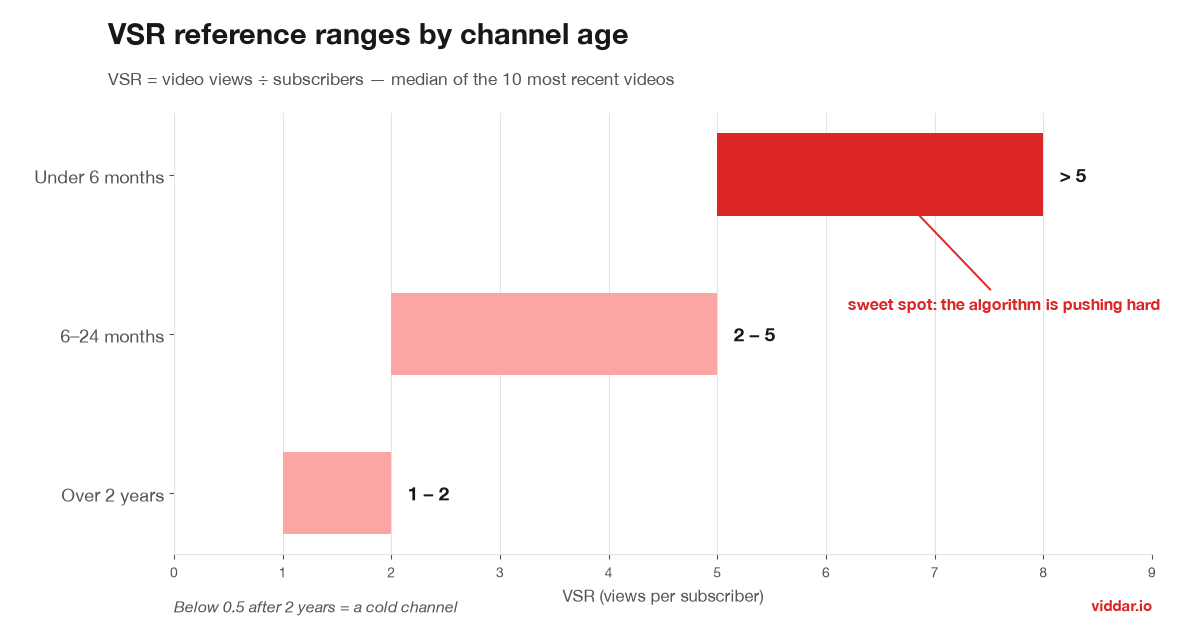
VSR reference ranges by channel age
There is no absolute threshold that fits every niche, but this is a practical frame when vetting (computed as the median of the last 10 videos):
| Channel age | VSR worth noting | Reading |
|---|---|---|
| Under 6 months | > 5 | The algorithm is pushing hard to new viewers — the niche is still hungry for content |
| 6–24 months | 2 – 5 | Healthy growth; demand still exceeds supply |
| Over 2 years | 1 – 2 | Stable; below 0.5 the channel has cooled no matter how large the sub count |
Mind the opposite direction too: a young channel stuck below a VSR of 1 across many consecutive videos is a sign the content isn't matching demand — change the angle before pouring in more production effort.
Use VSR at the niche level, not just the channel level
VSR's real power shows when you look at an entire niche instead of one channel: take the median VSR of the leading channels plus the channels created in the last six months. The niche worth entering is the one where both the young channels and the leaders hold a good VSR — proof that demand is not yet fully served. A niche where only the veteran channels still get views has frozen its rankings.
VSR is signal #1 in the 5-step process for finding low-competition niches — but it needs the other signals (channel age, saturation, monetization status) alongside it to avoid jumping to conclusions.
Four traps when using VSR
- Using the mean instead of the median. As in the example above — one viral video makes the whole channel look deceptively healthy.
- Mixing Shorts with long-form. Shorts have their own distribution mechanics and views that run orders of magnitude higher; blending them destroys the metric. Compare long-form against long-form only.
- Channels with bought subscribers. Fake subs inflate the denominator → artificially low VSR. The reverse holds too: an "impossibly high" VSR with near-zero engagement (comments, likes) deserves suspicion about where the views come from.
- Measuring right after an upload burst. Freshly published videos haven't accumulated views yet; make sure the 10-video sample is at least a few weeks old.
Automating VSR tracking
Computing VSR for one channel takes minutes; computing median VSR for thousands of channels across hundreds of niches, refreshed weekly, is not a by-hand job. Viddar pre-computes this metric for every channel and niche it tracks — you filter directly for "channels under 6 months old, VSR above 5" in Niche Hunter and get the list in seconds. If your path is a no-face channel, read on: faceless & AI YouTube channels in 2026 — where the door is still open covers how to apply VSR to exactly that family of niches.
VSR has the limits any single measure has. Even so, if you could look at only one number before committing to a niche, make it this one rather than the subscriber count.
The next niche is already on the radar.
Viddar scans long-form YouTube niche signals every day — free 3-day trial.
Try Viddar for free